
- Physical complaints
- Inflammation
Inflammation
Inflammatory response
Inflammation is the body's response to damage in connective tissue. This inflammatory reaction is essential for healing, as it helps replace damaged tissue. Damage isn't limited to large tears, fractures, or bruises, it also includes smaller injuries caused by overuse or micro-trauma.
An inflammatory reaction progresses through three distinct phases:
- Inflammatory phase.
- Proliferation phase.
- Organisation phase.
Phase 1. Inflammatory phase
When tissue is damaged, even minimally, it results in cell and blood vessel damage. This triggers the production of anti-inflammatory substances, which are carried in the blood. Proper blood circulation is therefore crucial for effective recovery. These substances promote healing.
The goal of the inflammatory phase is to clean the wound and activate cells for tissue repair. This process increases the sensitivity of nerve endings, leading to heightened pain sensation.
During this phase, blood vessels dilate to maximize blood supply to the affected area. This can cause warmth and redness (if near the surface). Increased blood flow also leads to the secretion of more fluid (plasma), resulting in swelling (edema). Swelling can be particularly problematic if it involves a joint, as it may limit movement.
The characteristics of an inflammatory reaction are:
- Pain.
- Redness.
- Swelling.
- Warmth.
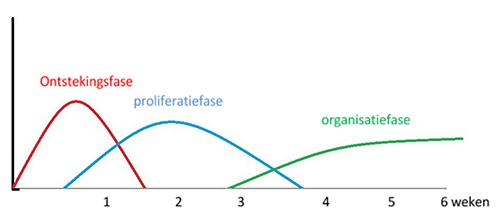
Phase 2. Proliferation phase (repair phase)
During the proliferation phase, tissue repair begins. The phases overlap and cannot be strictly separated (see image). This phase starts quickly, within a few days of injury. Its goal is to reduce the surface area of the wound and restore function. New connective tissue is formed, but it is initially weaker and more vulnerable than the original tissue. It is important to guide the new tissue towards its intended function. This means avoiding full loading but maintaining functional movement.
For example, a torn muscle must regain its full length and strength during recovery. If the muscle is kept shortened and immobile, it may remain shorter than before. Therefore, it is essential to move the muscle through its full range of motion.
Strength training with additional weights is not advisable during this phase because the tissue is still too fragile. Proper professional guidance is crucial.
Phase 3. Organisation phase
The organisation phase focuses on restoring the tissue to full function and increasing its load capacity. This involves strengthening the tissue, nerve fiber ingrowth, and reorganization of blood vessels. The new structure must also be recognized by the central nervous system.
Rehabilitation during this phase is tailored to the expected function of the tissue, which varies per individual. The load expected by a top athlete differs significantly from that of a less active person.
It can take up to 12 months for the newly formed connective tissue to become fully functional. Until then, microscopic changes continue to occur.
This does not mean the tissue cannot be fully loaded during this period, but rather that it gradually adapts to the required function over 12 months. The tissue should be loaded maximally but at the right time during rehabilitation to achieve optimal strength.
Risks
An inflammatory reaction is a natural and beneficial process. Everyone, regardless of fitness or health, experiences this reaction. The duration of each phase can vary depending on the extent of the injury and the individual. Proper blood circulation accelerates recovery by delivering anti-inflammatory substances more effectively to the damaged area.
If insufficient rest is taken during the inflammatory phase, the inflammation may persist. This is similar to a cut on a finger that never heals properly if it is repeatedly reopened.
Anti-inflammatory medications are often prescribed if the inflammatory phase lasts too long and significantly limits daily activities. These medications help the body progress through the inflammatory phase by reducing pain, allowing the tissue to be loaded again. However, there is a high risk of overuse, as the tissue remains weak from prolonged inflammation.
If pain is artificially reduced and mobility increases, there is a high risk of quickly overloading the tissue, leading to further overuse and reigniting the inflammatory reaction. Medication can be helpful, but it is crucial to gradually increase loading.
Summary
| Inflammatory phase (phase 1) | |
|---|---|
| Characteristics |
|
| Do |
|
| Risks |
|
| Proliferation phase (phase 2) | |
|---|---|
| Characteristics |
|
| Do |
|
| Risks |
|
| Organisation phase (phase 3) | |
|---|---|
| Characteristics |
|
| Do |
|
| Risks |
|
What can we improve according to you?
Let us know, your opinion is important to us.
Thank you for your feedback!
We will work even harder to improve the quality of Physiocheck.co.nz.
Did this information help you?
Related topics
- Asthma
- Back pain
- Bone fracture
- Breathlessness
- Bronchitis
- Bursitis
- COPD
- Cervical herniated disc
- Coughing up phlegm
- Cracking joints
- Diaphragm pain
- Discopathy
- Emphysema
- Fatigue
- Flat feet
- Floating rib syndrome
- Fluid in the ankle
- Fluid in the knee
- Fracture
- Funnel chest
- Groin pain
- Heel spur
- Herniated disc
- High blood pressure
- High-arched feet
- Hip dysplasia
- Hypermobility
- Iliotibial band friction syndrome
- Impingement syndrome
- Incontinence
- Inflammation
- Knee osteoarthritis
- Lower back pain
- Lumbago
- Muscle contusion
- Muscle cramp
- Muscle soreness
- Muscle strain
- Obesity
- Overuse
- Pigeon chest
- Pneumonia
- Polymyalgia rheumatica
- Referred pain
- Sarcopenia
- Scapula alata
- Sciatica
- Spondylosis
- Sprained ankle
- Tendinopathy
- Tendon inflammation
- Torn ankle ligament
- Tremor
- Types of bone fractures
- Worn hip